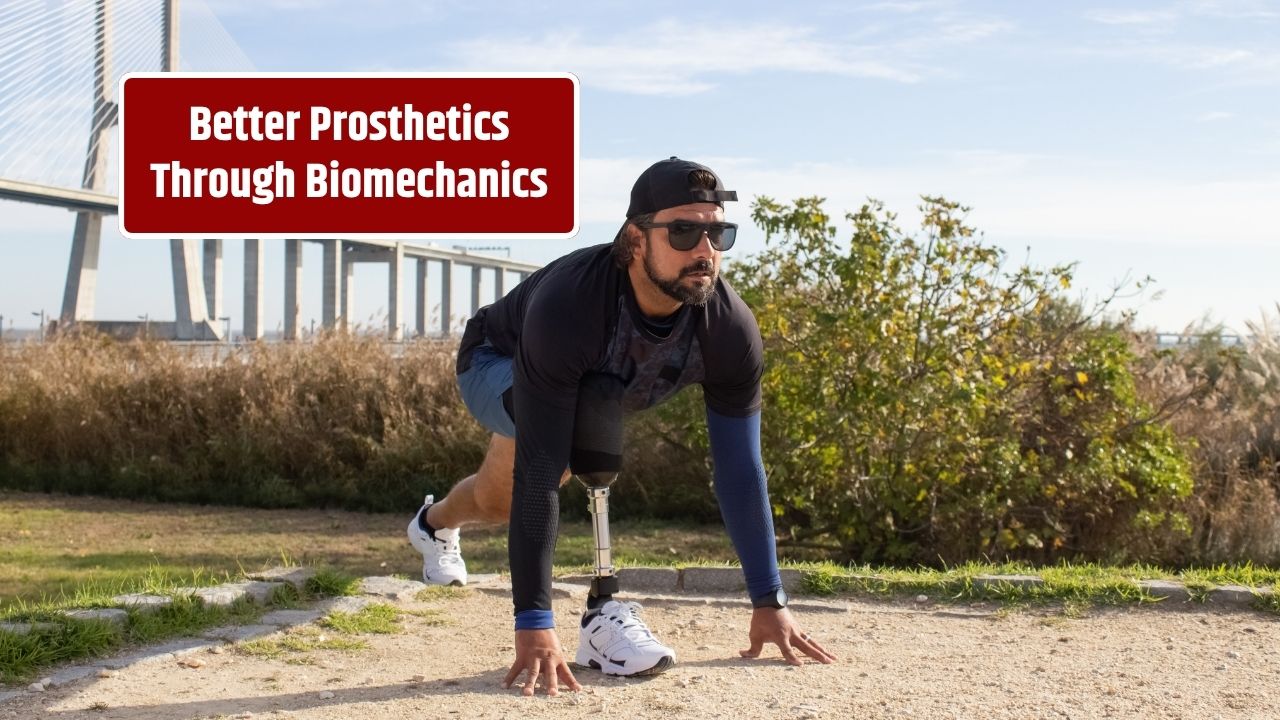
Prosthetic technology has come a long way—from wooden legs and rigid braces to today’s smart, lifelike limbs. At the heart of this evolution lies biomechanics, the science of how the body moves and interacts with forces. By applying mechanical principles to the design of prosthetics, biomechanics ensures these artificial limbs can mimic natural motion, improve mobility, and enhance quality of life for users.
Here’s how biomechanics plays a critical role in designing better, smarter prosthetics.
Understanding the Human Body Through Biomechanics

Before designing a prosthetic, engineers and clinicians must understand how the intact human body works. Biomechanics helps analyze:
- Joint movement and range of motion
- Muscle force and control
- Ground reaction forces during walking or running
- Gait patterns and weight distribution
By studying the body in motion, designers can create prosthetic limbs that more closely replicate the mechanics of real limbs.
Key Biomechanical Principles in Prosthetic Design
Several fundamental biomechanics concepts guide the development of prosthetic limbs:
1. Joint Kinematics

This refers to the motion of joints—such as how the knee flexes or the ankle rolls during walking. Prosthetics are built to match these movement arcs as closely as possible.
2. Load Distribution
Prosthetic limbs must distribute weight and force effectively to avoid discomfort, pressure sores, or long-term joint damage. Biomechanics ensures load is shared across the prosthesis and remaining limb evenly.
3. Energy Storage and Return
Some advanced lower-limb prosthetics use carbon fiber feet that store energy when the user steps down and release it to aid in the next step. This mimics the spring-like action of tendons and muscles.
4. Ground Reaction Forces

Understanding how the foot interacts with the ground helps design prosthetics that maintain balance and stability, especially during walking or uneven terrain navigation.
Applications of Biomechanics in Prosthetic Development
| Application Area | Biomechanical Impact | Benefit to User |
|---|---|---|
| Lower-limb prosthetics | Simulate gait patterns and reduce energy cost | Improved walking comfort and efficiency |
| Upper-limb prosthetics | Optimize range of motion and grip mechanics | Enhanced dexterity and control |
| Socket design | Analyze pressure points and limb alignment | Better comfort and reduced skin irritation |
| Sports prosthetics | Tune stiffness and responsiveness for activities | High performance in athletics |
| Pediatric prosthetics | Accommodate growth and natural movement | Better adaptation and long-term usability |
Smart Prosthetics and Biomechanical Feedback
Modern prosthetics now integrate sensors and microprocessors that respond in real time to biomechanical signals. For example:
- Myoelectric arms detect electrical activity from muscles to control hand movement.
- Microprocessor knees adjust resistance during walking or running based on the user’s gait.
- Feedback sensors monitor pressure, angle, and motion to prevent misalignment or strain.
These systems rely on biomechanical data to interpret user intent and optimize movement, creating a more natural and intuitive user experience.
The Role of Gait Analysis
After fitting a prosthetic, clinicians use gait analysis to fine-tune alignment and performance. This involves measuring:
- Step length and symmetry
- Hip and knee angles
- Ground reaction forces
By comparing the user’s motion to standard biomechanical models, adjustments can be made to improve balance, reduce fatigue, and prevent injury.
Looking Ahead: The Future of Biomechanics in Prosthetics
The next frontier combines biomechanics with AI, robotics, and 3D printing. Expect to see:
- Fully personalized prosthetics based on real-time motion capture
- Neuro-biomechanical interfaces that connect prosthetics to the nervous system
- Predictive models that adjust prosthetics for specific activities or terrains
These innovations promise even greater levels of freedom, comfort, and performance for users around the world.
FAQs
Why is biomechanics essential in prosthetics?
It ensures prosthetics replicate natural limb movement, distribute forces properly, and provide functional, comfortable solutions tailored to each user.
How does biomechanics improve comfort in prosthetics?
By analyzing pressure, force, and alignment, biomechanics helps design better sockets and limb fits that reduce pain and skin damage.
Can biomechanics help amputees perform better in sports?
Absolutely. It’s used to design lightweight, responsive prosthetics optimized for activities like sprinting, skiing, or cycling.
What role do sensors play in biomechanical prosthetics?
They provide real-time feedback on motion and pressure, allowing the prosthetic to adjust dynamically to the user’s movements.