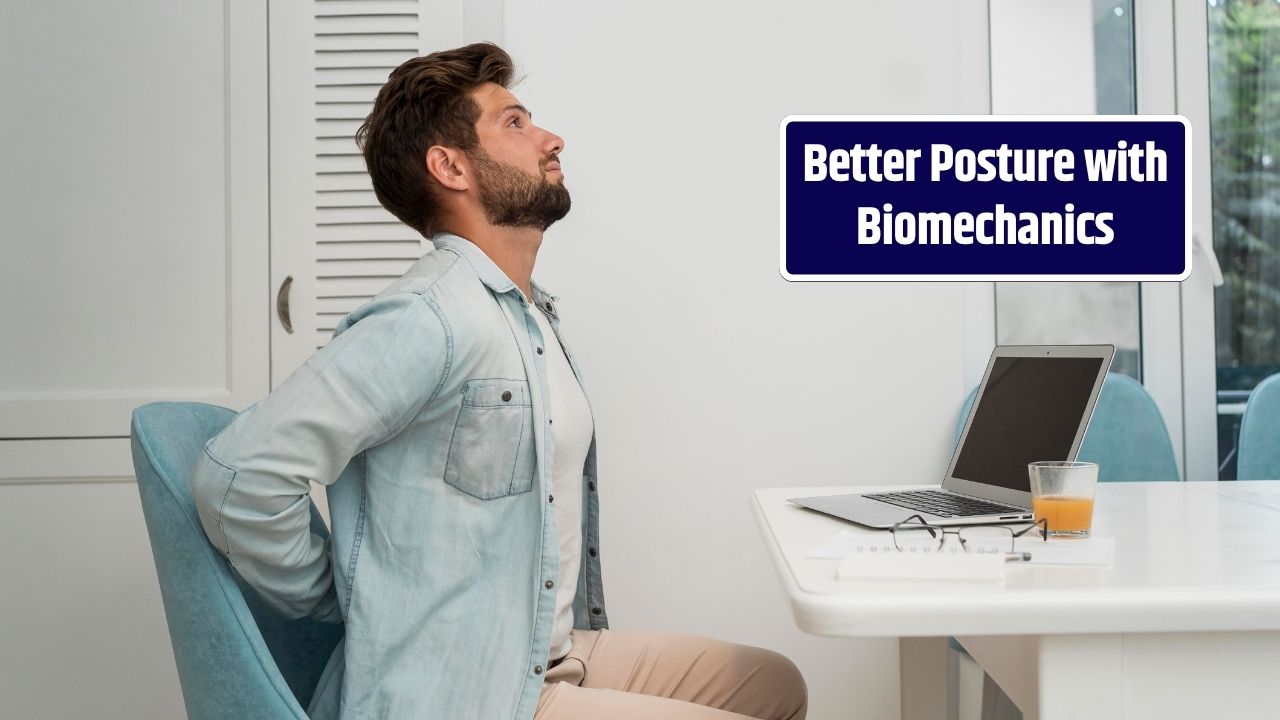
In today’s desk-bound world, poor sitting posture has become a widespread issue—leading to chronic back pain, neck strain, headaches, and reduced productivity. While many people turn to ergonomic chairs or lumbar cushions, the real solution lies in biomechanics—the science of how your body moves and functions.
Understanding biomechanics allows us to optimize how we sit, minimize joint stress, and reduce the risk of long-term damage. Here’s how biomechanics helps improve sitting posture and what you can do to sit smarter.
Why Sitting Posture Matters

Sitting may seem passive, but it actually requires dynamic muscular control to maintain proper alignment. Poor posture often results in:
- Increased pressure on spinal discs
- Muscle imbalances
- Reduced circulation
- Long-term joint stress
Over time, this leads to chronic musculoskeletal issues, including back pain, neck tension, and poor breathing mechanics.
The Biomechanics of Good Sitting Posture
From a biomechanical standpoint, proper sitting posture involves stacking your joints—keeping the head, shoulders, hips, knees, and ankles aligned to distribute force evenly.
Key Biomechanical Principles:
| Principle | Why It Matters |
|---|---|
| Spinal Neutrality | Reduces disc pressure and strain |
| Pelvic Alignment | Supports lumbar spine curvature |
| Joint Stacking | Promotes muscle efficiency and balance |
| Muscle Activation | Engages core and postural stabilizers |
How Biomechanics Helps Improve Sitting
1. Pelvic Positioning

Biomechanics teaches that the pelvis is the foundation of sitting posture. A posterior pelvic tilt (slouching) flattens the lumbar spine, while an anterior tilt (arching) can lead to hyperlordosis.
Fix:
Sit with your hips slightly above your knees, feet flat on the floor, and your weight evenly distributed on your sit bones.
2. Spinal Alignment
The spine should maintain its natural S-curve:
- Slight inward curve at the lower back (lumbar lordosis)
- Gentle outward curve in the mid-back (thoracic kyphosis)
- Inward curve again at the neck (cervical lordosis)

Fix:
Use a small lumbar support or adjust your chair back to support the lower spine while keeping the shoulders relaxed.
3. Head and Neck Position
Poor biomechanics often lead to forward head posture, which increases neck strain and tension headaches.
Fix:
Your ears should align with your shoulders. Keep your monitor at eye level to avoid looking down and placing stress on the cervical spine.
4. Core Engagement
Engaging the deep core muscles, like the transverse abdominis and multifidus, supports your spine during sitting.
Fix:
Sit tall and imagine a string pulling the crown of your head upward. Lightly activate your core without bracing or holding your breath.
5. Dynamic Sitting
Biomechanics supports the idea of micro-movement to avoid prolonged static postures. Muscles fatigue quickly when held in the same position, leading to slouching and strain.
Fix:
- Shift your weight periodically
- Perform seated stretches
- Stand or walk every 30–45 minutes
Table: Good vs. Poor Sitting Biomechanics
| Element | Poor Sitting Posture | Biomechanically Correct Sitting |
|---|---|---|
| Pelvis | Slouched or tucked under | Neutral, weight on sit bones |
| Lumbar Spine | Flattened or overly arched | Gentle inward curve supported |
| Head/Neck | Forward, chin jutting out | Aligned with spine, chin slightly tucked |
| Shoulders | Rounded forward | Relaxed, slightly back and down |
| Feet | Dangling or crossed | Flat on floor or footrest |
How to Apply Biomechanics to Your Workspace
- Chair height: Adjust so hips are slightly above knees
- Desk setup: Monitor at eye level, arms at 90 degrees
- Keyboard & mouse: Close enough to avoid reaching forward
- Footrest: Use if feet don’t reach the ground comfortably
If you work remotely or use a laptop, consider an external keyboard and monitor for better alignment.
FAQs
Can biomechanics help reduce back pain from sitting?
Yes. Biomechanically sound sitting reduces spinal compression and muscle fatigue, which are common causes of back pain.
Is sitting on a stability ball good for posture?
It can help engage core muscles, but prolonged use may lead to fatigue. It’s best used intermittently alongside proper sitting strategies.
How long can I sit before it becomes harmful?
It’s not about time alone, but movement. Aim to change positions or take breaks every 30–45 minutes.