Presenting a scientific poster isn’t just about standing next to your research—it’s about telling a story, engaging your audience, and leaving a strong impression in just a few minutes.
Whether you’re a student presenting your first poster or a researcher looking to sharpen your delivery, this guide will show you how to present your poster like a professional.
Understand the Goal of a Poster Presentation

Your poster isn’t just a summary of your paper—it’s a visual conversation starter.
A great poster presentation should:
- Communicate your research clearly and concisely
- Invite discussion and feedback
- Show your ability to explain complex ideas simply
- Build your reputation in your field
Step 1: Master Your Poster’s Structure
Before the event, review your poster like a script.
Know these key parts inside-out:
| Section | What to Cover When Speaking |
|---|---|
| Title & Author Info | Brief intro of yourself and the research goal |
| Introduction | Problem, gap in the field, and why it matters |
| Methods | Key techniques—keep it short |
| Results | Highlight only the most important data |
| Conclusion | What did you learn and why does it matter |
| Future Work | Optional: where your research is going next |
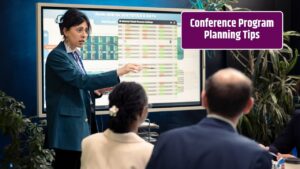
Practice a 2–3 minute summary—that’s about the average time you’ll have someone’s attention.
Step 2: Tailor Your Talk for Different Audiences
Not everyone walking up is from your field. Be prepared to adjust your explanation:
- Use simple terms when speaking to general attendees
- Dive into technical details if talking to an expert or fellow researcher
- Keep it interactive—ask, “Are you familiar with [topic]?” before diving deep
Step 3: Use the Poster as a Visual Aid, Not a Script
Point to graphs and visuals as you explain. Let the data guide the story.

Avoid:
- Reading text word-for-word
- Standing in front of your poster
- Blocking important content
Instead:
- Stand to the side, gesture confidently
- Maintain eye contact with your listener
- Use your finger or a laser pointer to highlight key data
Step 4: Engage Your Audience
Great presenters ask questions and invite conversation:
- “What’s your background in this area?”
- “We noticed this trend—what would you make of it?”
- “Have you seen similar results in your work?”
Bring a few extra handouts or QR codes that link to your preprint, lab site, or dataset for follow-up.
Step 5: Prepare for Questions—Even Tough Ones
Typical questions include:
- “Why did you choose this method?”
- “What were your controls?”
- “What are the limitations of your study?”
- “How would you scale this up?”
Don’t panic if you don’t know the answer. Be honest:
“That’s a great question. It’s something we’re exploring in follow-up work.”
Step 6: Dress the Part & Be Approachable
What you wear should reflect the event’s tone—business casual is standard.
Smile, be confident, and welcome people to stop by
Have a pen, notepad, or phone ready to jot down follow-up contacts
Stay at your poster during your scheduled session—don’t leave it unattended
Step 7: Practice… Then Practice Again
Rehearse with:
- Labmates or friends
- A timer to keep it under 3 minutes
- Different audiences (technical and non-technical)
Record yourself if possible—it helps refine your pace, tone, and clarity.
FAQs
How long should my poster pitch be?
Aim for a 2- to 3-minute explanation, with flexibility for deeper discussion.
Should I bring anything else?
Yes. Bring business cards, a QR code, or a one-page printout summary.
What if someone challenges my results?
Stay professional. Listen carefully and respond with confidence—or acknowledge areas needing more research.