Physiotherapy is not just about treating symptoms—it’s about correcting the root cause of dysfunction. And the most effective way to do that is by applying the principles of biomechanics, which looks at how the body moves and the forces acting upon it. When movement patterns are off due to injury, weakness, or poor posture, it creates imbalances that lead to chronic pain or re-injury. That’s where biomechanically informed physiotherapy techniques shine.
Here are the best physiotherapy techniques rooted in biomechanics that improve function, reduce pain, and restore healthy movement.
1. Gait Analysis and Retraining
How It Works:

Gait analysis assesses how a person walks and identifies abnormalities in foot strike, hip alignment, knee tracking, and muscle activation.
Biomechanical Benefit:
- Identifies asymmetries or compensatory movements
- Pinpoints sources of overuse injuries (e.g., shin splints, IT band syndrome)
Technique:
- Video gait analysis
- Treadmill training with feedback
- Specific cueing and drills to adjust stride and joint alignment
2. Postural Correction and Movement Re-Education
How It Works:
Physiotherapists assess static and dynamic posture to identify imbalances like forward head posture, anterior pelvic tilt, or scapular winging.
Biomechanical Benefit:
- Restores natural spinal curvature
- Reduces joint strain and muscle fatigue
Technique:
- Mirror feedback exercises
- Core activation training
- Scapular stability drills
- Proprioceptive neuromuscular facilitation (PNF)
3. Manual Therapy with Joint Mobilization
How It Works:
Involves hands-on techniques that apply specific forces to joints and soft tissue structures to improve mobility.
Biomechanical Benefit:
- Enhances joint glide and range of motion
- Reduces mechanical stress by restoring normal arthrokinematics
Technique:
- Grade I–IV joint mobilizations
- Soft tissue release
- Myofascial trigger point therapy
4. Neuromuscular Re-Education
How It Works:

Improves communication between the nervous system and muscles to correct faulty movement patterns.
Biomechanical Benefit:
- Restores coordinated, efficient movement
- Reduces compensatory muscle firing
Technique:
- Balance and proprioception exercises
- Muscle activation sequencing (e.g., glute activation in squatting)
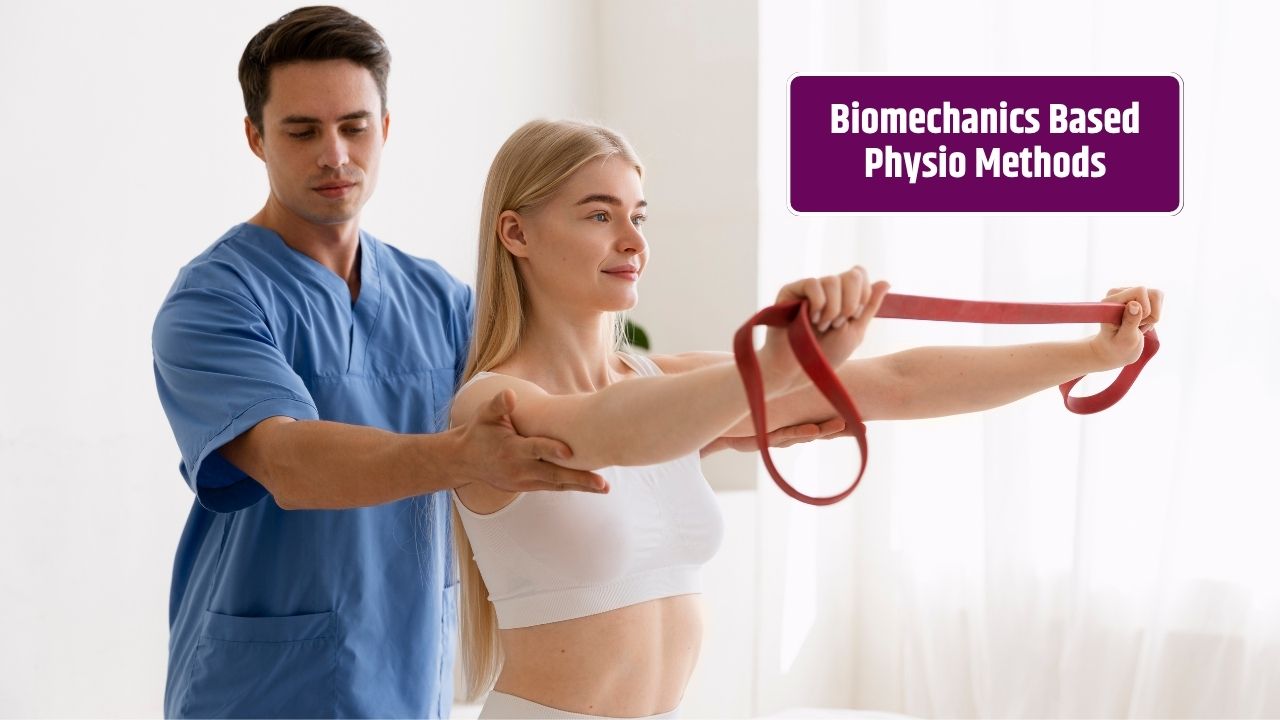
- Use of resistance bands and unstable surfaces
5. Functional Movement Screening (FMS)
How It Works:
This screen identifies weaknesses, mobility limitations, and asymmetries during fundamental movement patterns like squats, lunges, and reaching.
Biomechanical Benefit:
- Targets specific movement faults before pain or injury develops
- Customizes corrective exercise programs
Technique:
- FMS scoring (0–3 scale)
- Targeted mobility, stability, and strength training
- Reassessment over time
6. Kinetic Chain Assessment and Correction
How It Works:
Examines how multiple joints and muscle groups work together during compound movements.
Biomechanical Benefit:
- Addresses upstream or downstream issues (e.g., foot alignment causing hip pain)
- Promotes integrated, full-body movement
Technique:
- Whole-body analysis of movements like running, throwing, or lifting
- Corrective strategies at weak links in the chain
- Dynamic warm-ups and closed-chain exercises
7. Isometric and Eccentric Loading
How It Works:

Incorporates controlled muscle contractions that either maintain length (isometric) or lengthen under tension (eccentric).
Biomechanical Benefit:
- Strengthens tendons and improves joint control
- Reduces risk of overload injuries (e.g., Achilles tendinopathy)
Technique:
- Wall sits, planks, or single-leg holds (isometric)
- Slow, controlled lowering phases in exercises like Nordic curls or heel drops (eccentric)
8. Taping and Bracing Techniques
How It Works:
Uses kinesiology tape or braces to guide movement, support joints, or offload stressed tissues.
Biomechanical Benefit:
- Provides proprioceptive feedback
- Encourages better joint positioning and alignment
Technique:
- Kinesio taping for posture or pain reduction
- Patellar tracking tape for knee alignment
- Ankle braces during return to sport
Table: Summary of Biomechanical Physiotherapy Techniques
| Technique | Biomechanical Focus | Key Benefits |
|---|---|---|
| Gait retraining | Foot and limb alignment | Reduces joint load, corrects asymmetry |
| Postural correction | Spinal and pelvic alignment | Eases muscle strain and joint pressure |
| Joint mobilization | Joint mechanics | Restores mobility and reduces pain |
| Neuromuscular re-education | Muscle firing patterns | Improves coordination and balance |
| Functional movement screening | Movement quality | Prevents injury and enhances function |
| Kinetic chain correction | Interconnected joint function | Resolves referred pain and dysfunction |
| Eccentric/isometric loading | Tendon and joint stability | Strengthens weak points and prevents injury |
| Taping and bracing | Joint support and proprioception | Improves movement awareness |
FAQs
Are biomechanical physiotherapy techniques suitable for all patients?
Yes. These techniques are customized based on age, injury, and mobility level—from post-op rehab to elite athlete training.
Do I need advanced equipment for biomechanical rehab?
Not always. While gait labs and motion capture systems help, many assessments and corrections can be done with simple tools and expert observation.
How long before I see results?
Some biomechanical corrections—like improved posture or reduced pain—can occur within weeks. Long-term changes often require consistent retraining over months.